17 October 2007

WWII Manual for Iraq is Surprise Bestseller


When your current orders aren't clear, and you don't know how to deal with the locals, it is good to know that the University of Chicago Press is there for you. The academic publisher has just completed a rush order of 5,000 copies of Instructions for American Servicemen in Iraq during World War II.

The manual was originally created for US servicemen being sent to Iraq to assist the British troop contingent already in the country. Although Iraq was nominally independent since 1932, the country was largely a British protectorate. When the government of Arab nationalist Rashid Ali began to be a little too friendly with Nazi Germany in 1941, British troops landed in Basra to take formal control of the country, and stayed until 1947.

The manual for American troops has several passages that still apply just as well sixty years later:

"Don't be boastful or arrogant when talking to Iraqis."

"Never stare at or try to talk to Iraqi women."

"Learn a few Arabic phrases."

"Remember that Arabs are some of the most relentless guerrilla fighters in the world."

"Use your best manners."

The one that I wish Donald Rumsfeld et. al. had read is "American success or failure in Iraq may well depend on whether the Iraqis (as the people are called) like American soldiers or not. It may not be quite that simple. But then again it could."

Labels: , ,

11 October 2007

P.O. Box 1142, WWII Interrogators Speak

There was a very nice little article in the Washington Post this past weekend about a group of veterans sharing their war-time stories with the American public. There have been many such articles, especially since Ken Burns turned such reminiscences into a 14-hour documentary.

But this group of men was a little different. These 80-90 year-olds were the US Army's professional interrogators in WWII. They worked at a facility known only by its mailing address, P.O. Box 1142, and tucked into Virginia's Fort Hunt, along the Potomac River near Washington, DC. Here, the interrogators questioned Nazi scientists, U-boat men, officers, and leaders. Holding cells were bugged, and, in violation of the Geneva Convention, the Red Cross was not told of their location until they were transferred to a normal POW camp.

However, these veterans never committed the sort of physical and mental abuse now being meted out at Gitmo and CIA "black sites". Instead they often found that games of chess or even steak dinners did more to loosen the lips of their German captives. Many of these veterans made clear while they were being honored by the Army and the National Park Service for their war-time service, they did not approve of the move that America has made towards the new 'harsh interrogation' techniques that in the 1940's were more often found in the hands of the Gestapo than in the US Army.

Labels: , , ,

26 April 2007

What I'm Reading

Life may be hectic, but I have always felt that having something that you are reading is important. I thought I'd take a moment to cover two books, one I just finished and a second I've started to dig into.

First is The Utility of Force by General Rupert Smith. I was inspired to order this book after seeing Smith, a retired British general and former D-SACEUR in NATO, give history lessons to Jon Stewart on the Daily Show.

Although the book was only 400+ pages, it was amazingly dense with analysis of war and military power from the reforms of Napoleon to our current mess in Iraq. The main thrust was to show how the militaries of the West in particular are still wed to the idea of 'industrial war' that was created by revolutionary France and 'perfected,' for lack of a better term, in the two World Wars. The advent of the atomic bomb made that sort of war unwinnable. Instead, almost all wars since 1945 have grown out of the guerrilla tradition. Now we face what Smith inelegantly calls "war among the people." Instead of using strength and force to break the will of your enemy, we must capture the will of the people to break the strength of the enemy.

I'm really not doing justice to the book here. Smith is calling for a fundamental re-assessment of the purpose and organization of the military in a way that has not been seen since Clausewitz. It is not an easy read, but it does put all of the political and military fumblings in Iraq, Afghanistan, Lebanon, Palestine, Kosovo, Bosnia, and Chechnya in a stark,but now understandable framework. I wish it were required reading for any of our presidential candidates.

So, after a scholarly work of military theory, I decided to slip into my guilty reading pleasure, the sometimes pulpy alternate-histories of Harry Turtledove. In this case "The End of the Beginning," the second book in his "Days of Infamy" series. The point of departure is the decision by the Japanese to not only bomb Pearl Harbor on December 7, 1941, but to follow-up with an immediate invasion of the islands.

Folks can debate all they'd like whether the Japanese had the logistical ability to handle such a long-range operation, but I think Turtledove handles these questions pretty well. The interesting challenge with this series versus other alt-histories is that the invasion isn't likely to irrevocably change the world. In the World War series, alien invasion changes the world eventually beyond recognition. Turtledove's Great War series, has a much smaller point of departure (a dropped set of orders wrapped around some cigars), but has led to a version of WWII being fought in Ohio and Pennsylvania. Here, the Japanese hold the Hawaiian islands, but the most I can see that doing for them is to delay the inevitable for a year or so.

Turtledove is clearly aware that he is not playing with the fate of worlds in this series and instead limits his point-of-view characters to the island of Oahu and a few Americans training stateside for the inevitable US invasion. The trick works rather well; the reader finds themselves hanging on every rumor of the war in the wider world. The limited geography also helps to create more of a feeling of oppression and claustrophobia inherent in the occupied territory. In the end, it isn't great literature, but for a WWII geek like myself, it's an enjoyable read.

Labels: , , , ,

07 March 2007

Campaign for a Purple Heart Bond

Maybe this is off-topic, maybe not.

Reading the news articles about the utter debacle and poor conditions at Walter Reed Hospital has gotten me thinking about the continuing differences between the Iraq War (and larger War on Terror) and WWII.

Several other folks have commented on the lack of sacrifice requested of the American public in the wake of 9/11. And maybe the world is different now and cutting back on luxuries would only help our enemies. Maybe sacrifice on the home front - victory gardens, conservation, rationing - would do little to help in the fight.
However, I think most Americans can agree that our wounded veterans deserve the best medical care available. Iraq veterans are surviving wounds at amazing rates versus previous wars, but that means that the military and VA medical system are treating a much higher number of patients in long-term care than anyone expected from a war of this size, intensity, and length (assuming anyone expected it to be this long, this bad, and this large).

At the same time, other populations served by the VA are also facing crises. More American WWII vets die a day now than at the height of the fighting in the 40's. Vietnam Vets are heading into their 60s.
To serve all of these folks, the US government should build a network of top-notch, modern medical facilities. I'd like to see 21st Century hospitals and out-patient care facilities that any vet could walk into and staff will have immediate access to his full medical files. Take this opportunity to show what modern medicine can do for chronic injuries, end-of-life issues, and support in the home for the disabled. This new VA system can then serve as an example, and backbone for a more-modern national hospital system.

But how would you pay for such a grand system? I propose a Purple Heart Bond. Much like WWII's War Bonds, this plan would allow individual citizens to do more to help than stick ribbons on their cars. I would even guess that a fair number of these bonds would never be cashed, instead they would serve as patriotic reminders that we can sacrifice some luxury now to help those who need it, and in the end come out with something better than what we had before.

Labels: , , ,

13 October 2006

Echoes of WWII

A scan of today's news brings up a few interesting parallels between events today and and those of sixty-odd years ago.

First, the play "In Times of War" by David Alan Moore is playing in Chicago. Most Americans now are going to come out of this portrayal of the military tribunal trial of would-be Nazi saboteurs with thoughts of Guantánamo Bay and recent Congressional legislation on the handling of terrorism 'detainees'. However, the story itself, of a reluctant Nazi commando and his pricipled Jewish defense attorney, stands fine on its own. Most Americans have never heard of this story or even suspected that German agents had been landed on American soil.

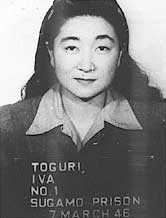
Elsewhere, Adam Gadahn has the dubious honor of being the first U.S. citizen to be formally charged with treason since the immediate post-WWII era. With the recent passing of Iva Toguri D'Aquino, who was convicted of treason (and later pardoned) for her role as Tokyo Rose, the issue of the use of treason law to punish propagandists is once again before us all.

WWII parallels don't magically make today's news clearer, but we should know that many have been down these paths before. It is worthwhile to examine the maps that they drew for us.

Labels: ,